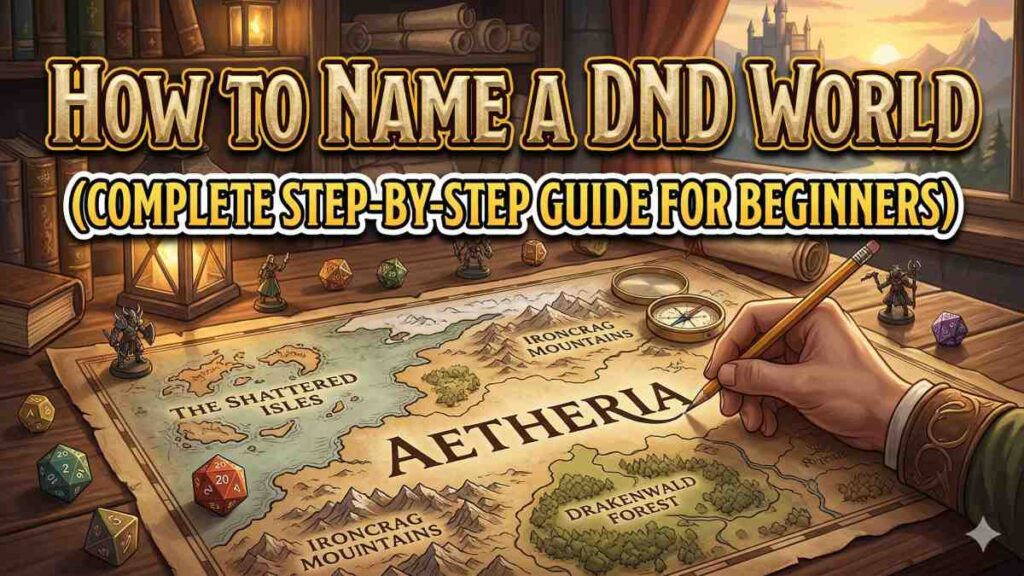
How to Name a DnD World: The Ultimate Guide for Dungeon Masters
When you sit down to run a game, the first thing your players encounter isn’t a dragon or a trap — it’s the name of the land they inhabit. A strong world name acts as a verbal handshake, introducing the vibe of your game before a single die is rolled.
Set your options and click "Generate Names".
Names generate instantly in your browser. No sign-up, nothing stored, no duplicates in a single batch.
What makes a good D&D world name
A name needs to stick. It should be unique and memorable rather than generic, easy to pronounce (if your players stumble over it, they simply won’t use it), and matched to the setting’s tone — a dark fantasy world shouldn’t be named something cheerful. The most common mistakes are overcomplicated names with too many apostrophes or unpronounceable consonant clusters, closely copying an existing famous fantasy setting (which pulls players out of your unique story), and using a random generator name with no meaning behind it at all.
Building a world name step by step
Define your world’s theme
A world of floating islands might suit a light, airy name; a gothic horror world needs something heavier and more somber.
Build the lore first
Names should come from the land’s history — who lived there first, what event shaped it — so the name feels earned rather than arbitrary.
Choose a naming style
Ancient Latin-sounding roots, modern English compound words, or a hybrid of both — pick one and apply it consistently.
Use linguistic patterns
Common prefixes and suffixes (like “-gard,” “-thas,” or “-ria”) create a cohesive feel across an entire map.
Test and refine
Say the name aloud ten times, and get a friend’s honest gut reaction before you commit.
Once your world has a name, you’ll need a title for the story happening within it — see our guide on how to name a D&D campaign.
Naming rules and consistency
Consistency is king. If one kingdom is named something exotic and multi-syllabic and the next is named something plain and mundane, the immersion breaks. Cultural influence should carry through your whole map — a Norse-inspired world should keep those hard, crisp sounds everywhere, not just in one region.
Fantasy naming techniques
Etymology
Take a real-world word (an Old English word for “valley,” for instance) and tweak it into something new but familiar.
Phonaesthetics
The study of how sounds feel — K, Z, and G often read as harsher or more villainous, while L, R, and V often read as heroic.
Geography-matched sound
A desert world might lean on “s” and “h” sounds to feel dry and sandy; a swamp might lean thick and muddy in its consonants.
Once your continents have names, make sure the people living there fit the culture too — see our guide on how to name a D&D character.
Naming different parts of your world
Continents
Broad, sweeping, ancient-sounding names — think in the scale of something like “Pangaea,” Earth’s own ancient supercontinent.
Kingdoms
Names that often reflect the ruling power or the land’s primary resource.
Cities & places
Focus on landmarks — a descriptive name built around a real geographic feature tends to stick in memory better than an abstract one.
Finding inspiration when you’re stuck
Try creative word combinations — take two unrelated words (“Cinder” and “Spire”) and see if the mashup (“Cinderspire”) fits. Mythology is a goldmine too, along with old maps of real forgotten civilizations, star names, plant names, or architectural terms. If you’re completely new to this, a simple formula — a color plus a noun, or a verb plus a place — is enough to get started, and scrambling the letters of your own name or hometown can spark something surprising.
Examples of strong D&D world names
Aethelgard — sounds ancient and noble. Iron-Reach — sounds rugged and industrial. Thalassia — sounds oceanic and magical. Each evokes an immediate image without needing further explanation, which is exactly the test a good world name should pass.
Frequently asked questions
What makes a good D&D world name?
It needs to be unique and memorable, easy to pronounce so players actually use it, and matched to the setting’s tone — a dark fantasy world shouldn’t carry a cheerful-sounding name.
What’s the biggest mistake DMs make when naming a world?
Overcomplicating it with too many apostrophes or unpronounceable consonant clusters, or closely copying an existing famous fantasy setting, which pulls players out of your unique story instead of pulling them in.
What’s the difference between naming a world and naming a campaign?
The world is the permanent, geographic setting your games take place in. The campaign is the specific story happening within it right now. Naming the world is about place; naming the campaign is about theme and stakes — they need different approaches.
Should I build the lore before or after picking a name?
Build at least a rough sense of the lore first. A name that comes from the land’s actual history — who founded it, what happened there — feels earned rather than picked at random, even if you only sketch that history in a few sentences.
How is naming for D&D different from naming a world in a novel?
A novel’s world name only needs to work on the page, where a reader can reread it if needed. A D&D world name is spoken aloud constantly, so it needs to be functional and easy to say and hear correctly during a live session.
Should I use a generator or name my world manually?
Generators are great for a quick town or minor location name. For the world itself, manual naming usually wins, since a generator doesn’t know your lore — only you do.