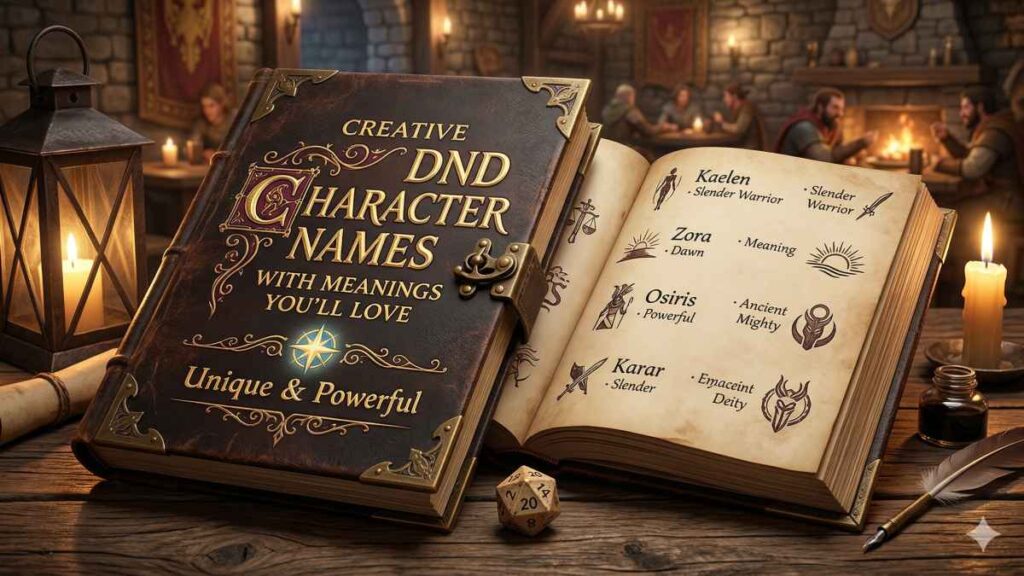
Creative DnD Character Names with Meanings You’ll Love (Unique & Powerful)
You’ve spent hours crafting the perfect backstory. Then comes that moment — the Dungeon Master asks, “What is your character’s name?” — and your mind goes blank. This guide collects creative DnD character names with meanings that tell a story before you even roll your first die.
Why a meaningful name matters
A name shapes personality before any dice roll. “Seraphina Whisperwind” suggests grace and mystery; “Grimstone Hammerfell” evokes dwarven resilience. Backstory gains depth through naming too — a warlock who took the name “Voidborn” after a ritual gone wrong carries that trauma into every introduction. Player immersion strengthens once the name fits the fantasy world so naturally that you stop thinking of your character as stats on a page. If you’re the one setting the stage for the whole party, our guide on how to name a D&D campaign is just as useful as naming the heroes themselves.
Building a name step by step
Understand the role
A paladin needs honor and strength; a trickster rogue might want something lighter and quicker; a forbidden-magic wizard calls for gravitas. See our full guide on how to name a D&D character for a deeper dive into matching name to roleplay style.
Use fantasy naming techniques
Combine two syllables from words you like — “Raven” plus “Ash” becomes “Ravash.” Consider cultural influence (Celtic for druids, Germanic for dwarves and barbarians) and play with syllable count to signal age or formality.
Add meaning
Light suggests hope or divine favor; shadow suggests secrets; fire suggests passion or rebirth. Choose a core concept that matters to the character and embed it in the sound.
Match the name to backstory
A name given by a parent who died, chosen after leaving the past behind, or given by an enemy in mockery and worn as armor — all of these deepen the emotional connection every time the name is spoken.
Names by category
Each name below tells a story on its own — pick the one that clicks for your character.
Male names
Aldric Thornwood — wise ruler of the forest edge; ideal for rangers or druids. Bram Ironheart — stubborn, fiercely loyal; a fighter whose courage never wavers. Caelum Starweaver — sky-touched scholar; ideal for wizards studying cosmic forces. Dorn Ashbreaker — a barbarian whose rage comes from hard-won freedom. Elias Dawnbringer — a paladin or cleric devoted to pushing back shadow. Fenrir Greyclaw — a ranger or barbarian with primal, wolf-touched energy. Gideon Truthseeker — an inquisitive rogue or paladin who cannot leave mysteries unsolved. Halden Quietstep — a rogue whose reputation precedes their silence. Ivar Stormcaller — a sorcerer or druid with elemental bloodline. Jasper Flint — a bard or rogue whose clever words start revolutions.
Female names
Lyra Silverveil — a bard whose songs reveal truth hidden beneath glamour. Morwen Shadowmere — a ranger or rogue comfortable in both darkness and light. Nyx Emberdusk — a warlock whose patron dwells in the shadows between. Orla Goldentongue — a bard or diplomat whose negotiation borders on magic. Phaedra Moonshadow — a cleric of the moon or a shadow-touched rogue. Rowan Swiftarrow — a ranger whose focus makes her unstoppable. Selene Nightshade — an assassin whose elegance conceals lethality. Tamsin Ironwill — a fighter whose determination matches any warrior. Vexia Spellweaver — a sorcerer whose power feels effortless yet devastating. Wren Holloway — a rogue or druid who knows things she shouldn’t.
Neutral names
Ash — reduced to essentials, ready to rise; works for any survivor of destruction. Cinder — what remains after fire; good for redemption or revenge arcs. Echo — a reflection of something lost; perfect for characters haunted by past selves. Hollow — intriguing for undead, constructs, or those missing something vital. Rune — fits any magic user or scholar of ancient things. Sable — an elegant choice for shadow-focused characters. Vale — good for travelers, guides, or protectors. Wraith — a dramatic choice for vengeance-driven characters.
Unique, cool & powerful names
Unique & rare
Aethelred Grimoire · Briar Roseveil · Corvus Blackfeather · Drustan Greyweather · Elara Voidsong · Faolan Direheart · Grimalkin Nightwhisper · Havoc Stormbrew · Isolde Mourningtide · Jareth Glimmerglass
Cool & stylish
Blade · Cypher · Draven · Kael · Maverick · Orion · Phoenix · Raven · Storm · Zephyr
Powerful & commanding
Ares Ironfist · Bastion Shieldheart · Conqueror Vex · Dominion Ashfall · Imperius Stormcrown · Magnus Doomforge · Overlord Nightbane · Rex Mortem · Titan Stonebreaker · Valor Dawnsinger
Aesthetic & poetic
Aurelia Goldensong · Calista Moondance · Elowen Starglade · Faelan Thornweaver · Ianthe Dreamweaver · Larkspur Morningdew · Opaline Shimmerveil · Rosalind Thornheart · Seraphina Emberlight · Vesper Twilightfall
Want to build something entirely from scratch instead? See how to create a unique fantasy name using linguistic roots.
Simple names for beginners
Brogan · Cora · Dane · Finn · Greta · Hank · Iris · Jack · Kira · Leo · Maeve · Nico · Otto · Pip · Quinn · Rosa · Sage · Tess · Ula · Vera — each easy to remember, quick to connect with, and still carrying real story potential.
Names by race
Different races have distinct naming traditions, reflecting cultural patterns while offering individual meaning.
Human names
Alaric Stonebridge · Brenna Darkwater · Conall Wolfhart · Della Fairwind · Eamon Brightwood · Fiona Lightfoot · Gareth Ironhand · Helena Trueheart · Ivan Frostholm · Janna Quickblade
Elf names
Aelar Leafwhisper · Celestine Glimmerwing · Elara Mistweaver · Faelan Moonshadow · Illyria Starwatcher · Lianthorn Silverbough · Mythal Dawnweaver · Nimue Stillwater · Orion Cloudrunner · Sylas Moondance
Dwarf names
Borin Stonehand · Dwalin Ironfoot · Grimm Copperbeard · Helga Strongbrew · Kili Deepdelver · Magni Goldheart · Orin Forgefire · Rurik Thunderhammer · Sigrid Shieldmaiden · Torvin Gemcutter
Names built on emotion and destiny
Emotion-based
Despair · Hope · Rage · Sorrow · Joy
Destiny-based
Fated · Pathfinder · Seeker · Wayfinder · Destined
Light vs. darkness
Dawncleaver · Nightrender · Shadebinder · Sunbreaker · Voidwalker
Mythology-inspired names
Ancient mythology is public domain and a rich source for fantasy naming — these carry the weight of legend while fitting any fantasy setting.
Greek-inspired
Ajax · Atalanta · Cassandra · Electra · Helios · Icarus · Medea · Orpheus · Perseus · Selene
Norse-inspired
Astrid · Bjorn · Erik · Freya · Gunnar · Helga · Magnus · Ragnar · Sigurd · Thorstein
Creative vs. unique, simple vs. powerful
Creative names blend familiar fantasy elements in a fresh way and help a character feel grounded in the world — good for a common human, for instance. Unique names break entirely from convention and suit a character from an unusual or isolated background, like an elf from unknown forests. Simple, one-or-two-syllable names (“Grom,” “Vex”) suit fast-paced, action-focused play. Powerful, three-or-more-syllable names (“Archibald Stormweaver,” “Lady Seraphina Ravenmoore”) suit characters with significant backstories or political weight. You can also hybridize — a powerful surname with a simple given name creates a nice balance.
Naming conventions worth following
Cultural patterns matter — elves lean on flowing vowels and soft consonants, dwarves favor hard consonants and guttural sounds, and humans show the widest variation. Linguistic consistency builds authenticity too: siblings or family members sharing certain sounds impresses Dungeon Masters and enriches the world. Avoid obvious pop-culture references, since naming a character directly after a famous existing character breaks immersion rather than adding to it — subtle inspiration works better than direct copying. Always test pronunciation aloud, and consider nickname potential, since an elegant elven name often gets shortened to something simpler within a few sessions anyway.
Frequently asked questions
Why does a character’s name need a meaning at all?
A meaningful name works as shorthand for backstory. Introducing yourself as “Thorn Ironvein” instead of “Bob the Fighter” instantly sets different expectations at the table, before a single die is rolled.
Should I pick a creative name or a fully unique one?
It depends on your character’s origin. Creative names blend familiar fantasy elements in a fresh way and help a character feel grounded in the world. Fully unique names break from convention entirely and suit a character from an unusual or isolated background.
Should I choose a simple name or a longer, more powerful-sounding one?
Match it to your campaign style. Fast-paced dungeon crawls favor short, one- or two-syllable names that are easy to shout mid-combat. Political intrigue and heavy roleplay benefit from longer, more formal names that carry weight and history.
Is it okay to reference mythology when naming a character?
Yes — ancient mythological names (Greek, Norse, and others) are public domain and a rich, appropriate source for fantasy naming. Just avoid naming a character directly after a copyrighted modern pop-culture character, which tends to break immersion rather than add to it.
Can a character’s name change during a campaign?
Yes, and it can be a powerful character moment. A coward who becomes brave might shed their original name; a villain seeking redemption might adopt a new identity entirely. Names given by others — allies, enemies, or family — can also reveal different sides of the same character.
Where can I get more name ideas if none of these fit?
Visit the D&D Name Generators Hub for instant, unlimited name ideas across every race and class, or see our guide on how to create a unique fantasy name if you’d rather build one from scratch.