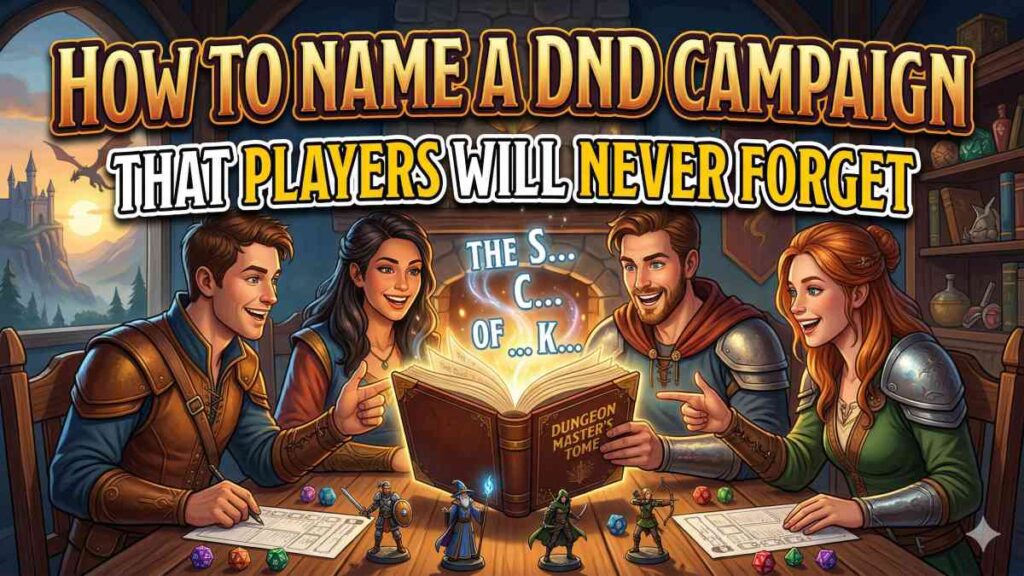
How to Name a DnD Campaign That Players Will Never Forget
Every great adventure deserves a title. A strong campaign name is the banner your players rally under, the legend whispered in taverns long after the final dice are rolled. This guide walks through a simple, step-by-step process for crafting one.
What makes a good campaign name
A successful title balances meaning, clarity, and creativity, resonating with your story while staying easy to remember and pronounce. Four reliable approaches: theme-based (the central mood — a quest for redemption, a struggle against fate), story-based (hinting at the central conflict or prophecy), character or villain-based (making the stakes personal), or setting-based (highlighting a specific, intriguing location).
Building the title step by step
Understand your story
What’s the core conflict? What should players achieve? The title should reflect the heart of the adventure.
Identify the theme
Dark, epic, funny, or mysterious — a gothic horror title sounds very different from a swashbuckling pirate one.
Pinpoint the anchor
A menacing lich, a forgotten kingdom, or a sacred artifact — find the one pillar your title can center on.
Brainstorm freely
List every related word — locations, objects, emotions — without censoring yourself yet.
Combine creatively
“Shadow” and “Crown” becomes “Shadow of the Crown” — this is where the magic happens.
Keep it catchy
Say your options aloud. The best titles are concise and easy for the whole table to recall.
Test with your players
Ask what kind of story they imagine from the name — their honest reaction is the real test.
While the campaign title sets the stage, your heroes need identities too — see our guide on how to name a D&D character.
Naming techniques and formats
Alliteration
The same starting sound creates rhythm — “Curse of the Crimson King.”
Symbolic naming
An object or concept representing a deeper theme — “The Shattered Scale” for broken justice.
“The [Adjective] [Noun]”
“The Emerald Expanse” or “The Sunken Citadel” — instantly recognizable and reliable.
“Rise/Fall of [X]”
“Rise of the Ash King” or “Fall of the Silver Spire” — implies scale and stakes immediately.
The same “adjective + noun” formula powers our Fantasy Book Title Generator, if you’d rather generate a batch instantly.
Ready-to-use name ideas by category
Story-based
Echoes of a Forgotten Oath · The Last Dawn of Serpent’s Reach
Setting-based
Whispers from the Hollow Wood · The City of a Thousand Tombs
Villain-based
The Umbral Marquis · In the Claws of the Iron Wyrm
Theme-based
A Dirge for the Godless (Dark) · The Gilded Galleon’s Heist (Fun)
Manual brainstorming methods
Mind mapping starts with a central concept (like “the villain”) and branches into related ideas (“ambition,” “bloodline,” “shadow”). Word association takes one key word from your campaign and lists everything it brings to mind, however loosely connected. Story keyword extraction means scanning your own campaign notes for the most evocative nouns and adjectives already sitting there. A campaign often centers on a specific realm too — the Kingdom Name Generator can give that realm a sense of history and scale in seconds.
Avoiding a bad campaign name
Steer clear of stacking multiple invented words together (a mouthful is a mouthful, however cool it looks on paper), picking something players can’t recall after one session, choosing a name with no real connection to the story’s tone, and directly copying a famous title from a book, movie, or another table’s campaign — inspiration is fine, direct copying reads as unoriginal.
A simple beginner formula
Identify your main story element (villain, location, or object), pick one strong adjective and one strong noun related to it, and combine them using one of the structures above — for example, “The [Cursed] [Amulet]” or “Secrets of the [Sunken] [Temple].”
Frequently asked questions
What makes a good D&D campaign name?
A title that balances meaning, clarity, and creativity — it should resonate with the story you’re telling while staying easy for your table to remember and pronounce.
What’s the difference between a campaign title and a campaign name?
A campaign title is the formal, public-facing version — good for a logo or an introductory session. The campaign name is what you and your players actually call it informally at the table. Sometimes they’re identical; sometimes a grand title gets shortened to something simpler among friends.
Should I name the campaign after the villain, the world, or the plot?
Any of the four core approaches works: theme-based (the central mood), story-based (the central conflict), character or villain-based (making the stakes personal), or setting-based (highlighting a location). Pick whichever element is genuinely the heart of your story.
How long should a campaign name be?
Either works, depending on tone. Short names like “Nightfall” are punchy and easy to remember. Longer, more descriptive names convey a richer premise at a glance. Neither is objectively better — it depends on what you want the name to promise.
What’s the biggest mistake to avoid when naming a campaign?
Overcomplicating it with multiple invented words strung together, or picking a name that has no real connection to the story — a name like “The Goblin Stomp” feels off for a serious, world-saving epic.
Is it okay to use a generator for campaign name ideas?
Yes, as a starting spark — but a hand-crafted title built from your own campaign’s specific keywords and story beats will almost always fit better than a generic generated one, since a generator doesn’t know your lore.