100+ Unique DnD Character Name Ideas (Cool, Funny, Powerful & More)
You just rolled a new character. The stats are perfect, the backstory is tragic — but they don’t have a name yet. This guide collects 100+ unique DnD character name ideas ranging from silly to epic, so nothing kills the mood by saying “my fighter attacks” with no name attached.
What makes a good D&D character name
A strong name balances three things: it’s easy for the whole table to remember, it matches your race or class, and it carries a genuine fantasy spark. Elves lean on soft vowels, dwarves lean on hard consonants, orcs sound guttural — once you notice these patterns, you can invent names on the fly instead of relying on a list. For a deeper foundational strategy, see our guide on how to name a D&D character.
Choosing a name step by step
Look at your character sheet
A wizard needs a studious name, a rogue needs something shadowy — don’t name your paladin “Snake.”
Match the personality
Grumpy, cheerful, or mysterious — the name should whisper the vibe before you say a word.
Borrow from history or myth
Change one letter — “Alexander” becomes “Alexandros” — for instant fantasy flavor.
Keep it simple
Something that rolls off the tongue beats “Xylophone the Destroyer” every time.
100+ character name ideas by style
Read slowly, say them out loud, and find the one that clicks.
Best for Beginners
Finn · Tara · Bren · Lila · Orin · Sera · Kael · Rori · Tess · Vance
Cool (Male)
Zephyr Nightshade · Kaelen Stormveil · Darian Ashford · Ronan Ironheart · Soren Blackwood
Cool (Female)
Seraphine Vex · Morrigan Dusk · Valerya Cinder · Nyx Shadowglen · Lyra Frost
Gender Neutral
Phoenix · Raven · Sage · Wren · Ash · Onyx · Rowan · Blair · Quinn · Remy
Funny Party Names
Sir Kicks-a-Lot · Barrel · Grumble Guttersnipe · Kevin the Acceptable · Not a Gnome · Stabs McCorgi
Powerful & Badass
Thorne Umbra · Magnus Bloodbane · Vexia Doomweaver · Korgath Stonefist
Aesthetic & Poetic
Elowen Mistyvale · Caelum Duskwhisper · Isolde Softpetal · Thalia Morningdew
Unique & Rare
Xanthe · Iskra · Zephyrine · Haleth · Quill · Vesper · Clove · Tallow
Names with meanings, for extra backstory depth
A name is more than a label — it’s a story. Something like “Griswold” (grey forest) implies a ranger lost in the woods before you’ve written a line of lore.
Albwin
“Elf friend”
Dagmar
“Glorious day”
Leofric
“Dear ruler”
Siglind
“Victory, soft”
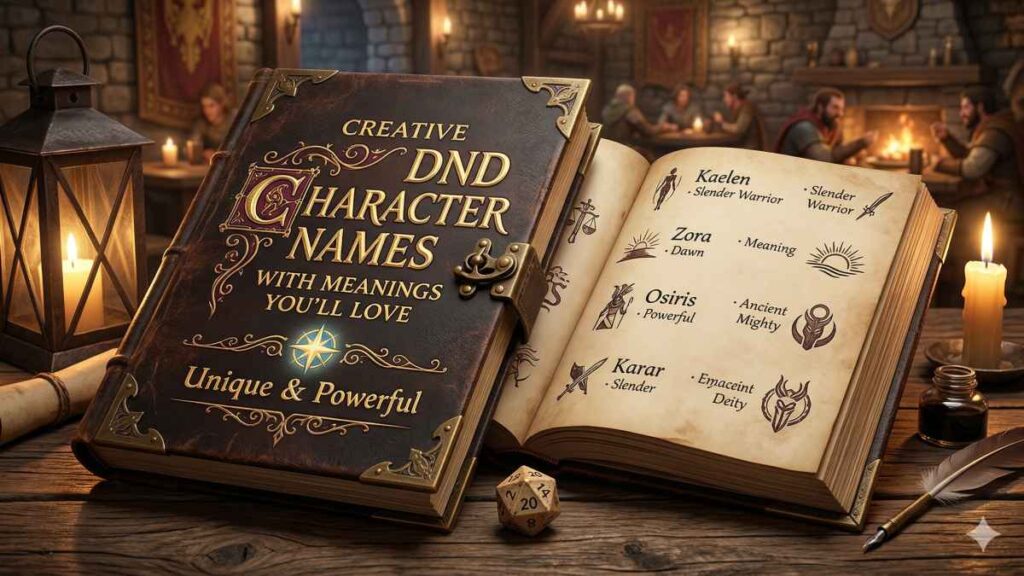
For a full curated collection, see creative D&D character names with meanings.
Names by race and class
Sometimes you need precision rather than a general list. Elves use lyrical sounds — Aelar, Liadan, Theron, Ielenia. Dwarves need thick, rock-like syllables — Bromur, Helga, Torvin, Dagna. Humans are flexible — Aldric, Rosalind, Godfrey, Elara. Wizards deserve studious, mystical names — Archimedes, Vesuvius, Theodora, Phineas. Rogues need shadowy, quick sounds — Vex, Silas, Whisper, Mirage. For a deeper dive into every race’s naming style, see the full D&D race-based name generators collection.
Generators vs. hand-picked names
A generator is a Dungeon Master’s best friend during a live session and works well for NPCs or when you’ve hit writer’s block — visit the Mythic Name Forge generator hub for every tool in one place. But remember that generated results can repeat within casual browsing, so treat them as a spark rather than a guaranteed final answer for your main character.
Common mistakes to avoid
Too complicated
“Aeronwyndelphia” will be shortened to “Aero” by session two anyway.
Hard to pronounce
If the DM stumbles over it every time, simplify it before it becomes a running joke.
Copying famous characters
“Drizzt Junior” is lazy — use famous names as inspiration for tone, not a template to lightly reskin.
Pro tips from experienced players
Keep names memorable using alliteration or rhyme — something like “Bramblewick Brine” sticks better than a random string of syllables. Match the campaign’s theme; a grim horror game needs darker names than a comedy one. And test pronunciation by saying the name ten times fast — if you trip over it, simplify it before your first session.
Frequently asked questions
What makes a good D&D character name?
A strong name balances three things: it’s easy for the whole table to remember, it matches the character’s race or class, and it has that distinct fantasy spark. A barbarian named “Lily” only works if it’s meant as an intentional joke.
How do I choose a name if I’m completely stuck?
Look at your character sheet first — a wizard needs a studious-sounding name, a rogue needs something shadowy. Then match the personality (grumpy, cheerful, mysterious), and keep it simple enough to say without stumbling.
What’s the difference between a D&D name and a general fantasy name?
D&D names are designed for gameplay — short, easy to shout across a tavern, and quick to say aloud repeatedly during a session. Fantasy names for books or films can be longer and more complex because readers see them written, not spoken live at a table.
What’s the biggest mistake people make when naming a character?
Overcomplicating it. A name like “Aeronwyndelphia” will just get shortened to “Aero” by the second session anyway — starting simpler saves everyone the trouble, including you.
Is it okay to base a name loosely on a real historical name?
Yes, and it’s a common technique — changing one letter or sound in a real historical name (“Alexander” to “Alexandros”) can produce something that feels instantly fantasy-appropriate without starting from a blank page.
Should I avoid copying names from famous D&D characters?
Yes — naming your character as a direct knockoff of a well-known published character reads as lazy and can pull other players out of the story. Use famous names as inspiration for tone and sound, not as a template to lightly reskin.