How to Play Dungeons and Dragons (Beginner’s Step-by-Step Guide)
Dungeons & Dragons isn’t just a game — it’s a shared story where you and your friends become the heroes. This guide teaches you how to play from absolute zero: gameplay, setup, character creation, and even solo options. No prior experience needed.
What D&D actually is and how it works
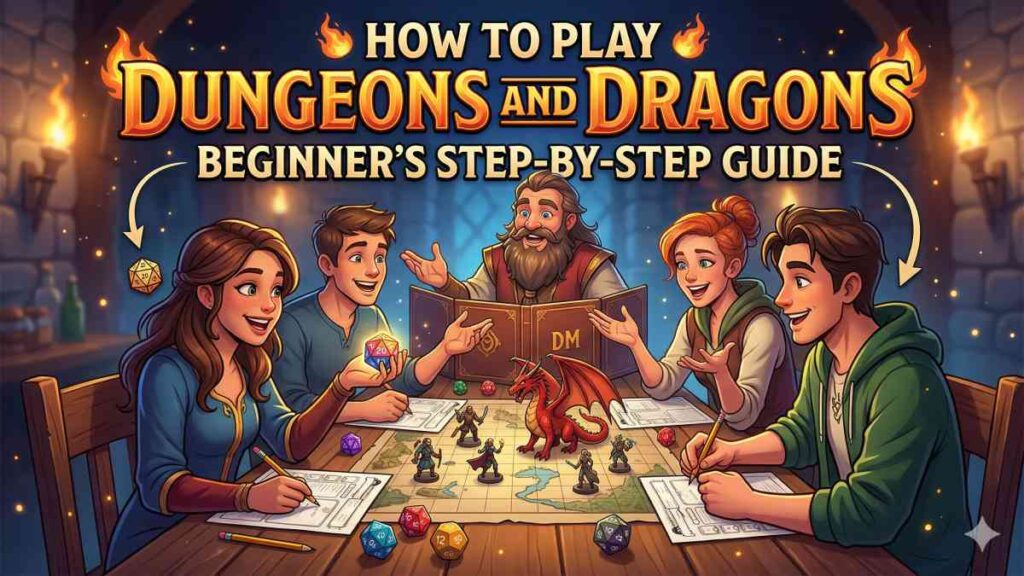
You sit around a table (real or virtual), describe what your character does, and roll dice to see if you succeed. One person acts as the Dungeon Master (DM) and describes the world; everyone else plays a hero. You say what you want to do, the dice decide the outcome, and no two sessions play out the same way. To make your setting feel more immersive once you’re comfortable with the basics, see our guide on how to name a D&D world so your geography feels ancient and real.
Playing step by step
Gather players and assign roles
You need at least two people — one Dungeon Master, and the rest as player characters running their own heroes.
Create your character
Choose a race (elf, dwarf, human, and more) and a class (fighter, wizard, rogue). Your race gives you traits, your class gives you abilities — a halfling rogue plays very differently from an elf wizard. Fighter is the classic beginner pick: straightforward, no complex magic to track.
Understand your character sheet
It lists your name, race, class, level, ability scores, equipment, and special moves. Higher numbers are generally better — keep it nearby every session.
Learn the dice system
A full set includes a d4, d6, d8, d10, d12, and d20. The d20 decides almost everything — attacks, saving throws, and skill checks. The DM tells you what to roll, you add your bonus, and announce the total.
Start your first campaign
A campaign is a series of connected adventures with a setting, a problem, and goals for the players. Your DM introduces a hook — “a goblin stole the mayor’s sword” — and your job is deciding what to do about it. That’s it, you’re playing.
Once you’ve picked your class, the next hurdle is finding the right identity — see our guide on how to name a D&D character to give your hero a soul. If you’re leading the group, you might also want to know how to name a D&D campaign to set the right tone from day one.
Gameplay basics
Combat follows a clear rhythm: everyone rolls for initiative, and the highest roll acts first. On your turn you can move and take one action — attacking, casting a spell, or hiding. Some abilities let you act outside your turn as a reaction. Outside of fights, you use skills like Persuasion to talk your way through a problem or Perception to spot hidden clues. As you gain experience, your character grows stronger and gains new powers every few sessions.
What you need, and how to get started
Very little is required to begin — a starter kit usually includes basic rules, dice, pre-made character sheets, and an introductory adventure, though many beginners just borrow dice at first. To start, decide who will DM (that person reads the basic rules first), then hold a “session zero” — a meeting without gameplay to discuss expectations, character ideas, and scheduling. Mistakes will happen, and that’s completely fine; the most common beginner mistake is trying to learn every rule before the first session instead of learning as you go. Once you’re settled on a character, browsing 100 unique D&D character name ideas can help you land on something that fits your hero’s personality.
Playing online, or without a group nearby
Virtual tabletops like Roll20 and Foundry let you see maps, move tokens, and roll digital dice, with Discord handling voice chat. D&D Beyond offers free character builders and digital rulebooks with automatic dice rollers built in. Playing with friends online works exactly like a home game — you just use screens instead of a physical table. If no local group is nearby, check local game stores for open D&D nights, library or community center clubs, Meetup.com, Facebook groups, or Reddit’s r/lfg (Looking For Group).
Becoming a Dungeon Master
Running a game starts with confidence, not professional writing skill — your main job is describing scenes and asking “What do you do?” Prepare a few encounters, not entire novels, and don’t be afraid to borrow ideas from movies you love and just change the names. Give every player equal attention; if one person is quiet, ask them directly, “What does your character think?” Roleplay gets easier with practice too — you don’t need a voice, just describe one clear emotion (“My character is nervous”) and build from there. Giving your character one clear goal and one flaw (greedy but loyal, brave but forgetful) creates better stories than a perfect character ever could. Names carry weight here too — creative D&D character names with meanings can add a layer of hidden lore to how your character comes across at the table.
Why people enjoy it
D&D gives you the freedom to try anything — want to bribe a goblin with a stolen pie? You can. New players often laugh hardest when their plans fail; a critical miss on a stealth roll frequently becomes the story everyone retells for years. Beyond fun, it builds real skills: problem-solving and resource management, creativity from imagining solutions no rulebook predicted, and social skills like teamwork, patience, and reading other people’s reactions.
D&D compared to other games
Compared to Pathfinder, D&D 5th Edition is simpler and faster to pick up, while Pathfinder offers more rules depth and character customization. Compared to board games, the comparison barely holds — board games have fixed rules and a defined ending, while D&D has essentially infinite possibilities. No board game lets you befriend the dragon instead of fighting it.
Frequently asked questions
Is Dungeons and Dragons hard to learn?
No, it feels harder than it actually is. The first session is usually a little clumsy, but by the third session most of the basics click into place — you don’t need to master every rule to have fun.
What is the best D&D class for a beginner?
Fighter is the classic beginner recommendation — it’s straightforward, you hit hard and take hits, and there’s no complex spell list to track while you’re still learning the basics.
How long does a D&D session or campaign take?
A single session usually runs two to four hours, though some groups play shorter one-hour lunch games or longer eight-hour marathons. A full campaign can wrap up in three sessions or run for years — there’s no wrong answer.
Can I play D&D without a Dungeon Master or by myself?
Yes to both. Without a DM, the group shares control and takes turns describing what happens using a cooperative storytelling mindset. Playing solo usually involves tools like a solo adventuring toolbox that uses random tables to generate dungeons, NPCs, and events.
What do I actually need to start playing?
Very little to start: the free basic rules online, one set of polyhedral dice, and paper for a character sheet. A full starter kit with pre-made characters and an introductory adventure is a good next step once you’re hooked.
What’s the biggest mistake beginners make?
Trying to learn every rule before playing, and writing an elaborate backstory before the first session. Start simple, learn the rules as you go, and let your character’s story develop at the table instead of on paper beforehand.